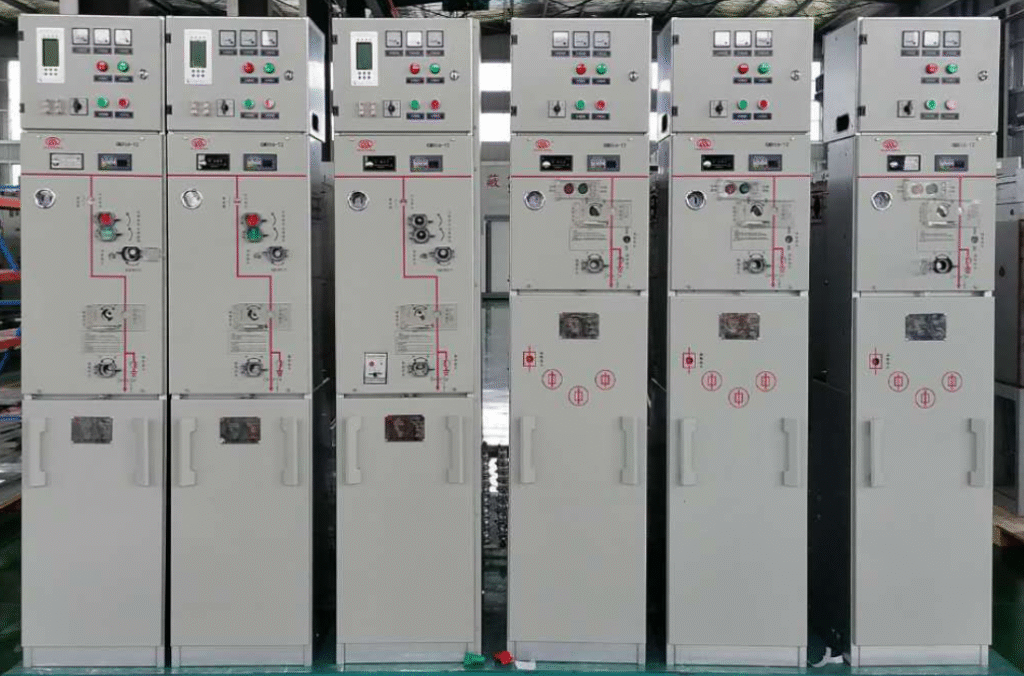
Functions and Manufacturing Technology of Each Compartment in a Ring Main Unit (RMU)
✅ 1. Functional Compartments/Enclosures of a Ring Main Unit (RMU)
Compartment / Enclosure
Primary Function
Switchgear Compartment
Houses load-break switches, circuit breakers and earthing switches for making or breaking current, short-circuit interruption and earthing.
Fuse Compartment
Accommodates high-voltage current-limiting fuses that, in combination with the load-break switch, protect transformers against overload and short-circuit.
Operating-Mechanism Compartment
Contains manual or motor-operated spring-charged mechanisms for closing, opening and earthing operations.
Cable Compartment (Base Frame)
Provides space for cable entry/exit, fixing, earthing, and installation of current/voltage transformers and zero-sequence CTs.
Metering & Control Compartment (optional)
Installs secondary devices such as protection relays and DTU (Distribution Terminal Unit) to enable “remote measurement, remote signalling and remote control”.
Gas Tank / SF₆ Enclosure
A sealed tank that encloses the main primary components (three-position switch, busbars), filled with SF₆ or an eco-friendly gas for insulation and arc extinction.
✅ 2. Manufacturing Processes of Ring Main Units (SF₆-insulated type as example)
Stage
Description
Enclosure Fabrication
3 mm stainless-steel plates are laser-cut and welded, ensuring a leakage rate ≤ 0.01 % per year.
Gas-Tank Assembly
Load-break switches, busbars and three-position switches are modularised and installed inside the sealed tank, which is then filled with SF₆ or eco-friendly gas.
Cable-Compartment Assembly
Integrates plug-in type CT/VTs, cable clamps, PT elbows and zero-sequence CTs for reliable connections and easy maintenance.
Secondary Wiring
Secondary devices (protection relays, DTU) are mounted on the door or in the control compartment, followed by wiring and functional tests.
Testing & QA
Includes power-frequency withstand tests, partial-discharge tests, gas-tightness checks and lightning-impulse tests.
Automated Production Line
MES system and automatic helium-leak detection equipment realise full-process automation, traceability and quality control.
✅ 3. Typical Structural Types Comparison – American vs European
Type
Features
American Common-Tank
All circuits in one enclosure, compact footprint, maintenance-free, suitable for outdoor use.
European Common-Tank
Separate compartments for each functional unit (switchgear, busbar, etc.), modular design, easy extension and maintenance.
Individual Gas Tank (Air-insulated or Gas-insulated)
Each functional unit has its own sealed tank with SF₆ or eco-gas insulation, ideal for urban networks demanding high reliability.
The entire production cycle can be summarized in five main phases: enclosure fabrication → primary assembly → secondary wiring → testing → shipment. Each step is governed by strict workmanship and quality-control checkpoints.
1. Enclosure Fabrication
Material: 2.5–3 mm non-magnetic stainless steel (SUS 304).
Enclosure Features – Double-door design: front door for operation & metering, rear door for cable compartment, both with three-point locking. – Pressure-relief channel: bottom or top vent flaps to direct arc gases safely outward during internal arc faults.
2. Primary Assembly
Gas-Tank Pre-assembly – Robotically welded “sealed for life” tank, leakage rate ≤ 0.1 % per year. – Vacuum evacuated, then back-filled with SF₆ or dry air slightly above atmospheric pressure; 30-year maintenance-free.
Main-circuit Module Installation – Three-position switch (close–open–earth) + busbars + vacuum circuit breaker / load-break switch pushed into the tank as a complete module.
Cable Compartment Fit-up – Integrated CTs/VTs, zero-sequence CT, cable clamps, separable PT elbows positioned for zero cable crossing and easy maintenance.
Operating Mechanism Mounting – Spring-operated mechanism coupled to the three-position switch; manual and motor charging, mechanical position indication and interlocking adjusted simultaneously.
3. Secondary Wiring & Protection System
Device Installation – Relays, DTU, auxiliary relays, temperature-humidity controller, compartment lighting mounted on door or dedicated metering cubicle.
Wiring Practice – Harness routed in cable ducts or corrugated conduits, dual-end ferrules; CT secondary circuits earthed at one point.
Terminals & Labelling – Screwless spring-type terminals, segregated incoming/outgoing sides; each wire carries both QR code and text labels for full traceability.
4. Testing & Quality Control
Test Item
Content / Standard
Power-frequency withstand
1.2 Ur for 1 min, no flashover
Partial discharge
≤ 5 pC @ 1.1 Ur
Gas tightness (helium)
≤ 0.1 % annual leakage
Mechanical endurance
3-pos switch ≥ 5 000 operations
Secondary injection
Verify pickup & timing of overcurrent, earth-fault, differential relays
Primary injection
100 % In through primary circuit, verify CT ratio & phase
Routine Factory Test (FAT)
Witnessed by customer or third party; test certificates & reports issued
5. Final Inspection, Packing & Shipment
Final Check – Appearance, labels, keys, spare-parts list; door opening angle ≥ 120°, locks smooth.
Packing – PE film wrap + fumigated plywood crate + desiccant; shipping marks “moisture-sensitive”, “keep upright”, “fragile”.
Documentation – Factory test report, certificate of conformity, wiring diagrams (AutoCAD PDF), O&M manual, warranty card.
6. Typical Production-Line Layout (minutes per station)
1 Enclosure loading → 2 Gas-tank welding/leak test → 3 Primary module insertion → 4 Secondary wiring → 5 Complete unit testing → 6 Packing → 7 Warehousing/shipping MES integration records welding parameters, SF₆ fill data and test curves in real time for full traceability.
The above process complies with IEC 62271-200, IEC 62271-103 and GB 3906 requirements and can be fine-tuned for solid-insulated, eco-gas or primary-secondary integrated RMUs.
The assembly line for electrical equipment components is an automated or semi-automated production system specifically designed for the power industry to efficiently and accurately assemble various key parts of electrical equipment. These components may include circuit breakers, isolating switches, insulators, transformer components, cable connectors, etc., which are the fundamental elements of power systems and are…
The reason why partial discharge (PD) testing of ring-main units (RMUs) must be carried out inside a shielded room (Faraday cage) is that PD signals are extremely weak (pico-coulomb level, pC), while the on-site electromagnetic environment is complex and the background interference is much higher than the real signal. Without shielding, the test data will…
Gas-tightness tests on SF₆ ring-main units are mandatory because leakage erodes dielectric strength, risks explosion and releases the world’s most potent greenhouse gas. A 0.5 % annual limit safeguards grids, complies with F-Gas/Kyoto rules and preserves carbon credits worth ~1 900 $ per avoided kilogram. Factory helium mass-spectrometry (10⁻¹¹ Pa·m³/s) guarantees zero defects; field pressure-decay…
1. Composition of KYN28 Switchgear KYN28 (also known as KYN28-12 armored withdrawable metal-clad switchgear) is a 10 kV distribution assembly widely used in power systems. It consists of two main parts—the enclosure and the withdrawable truck (draw-out circuit-breaker compartment). Internally it is divided into four independent, fully segregated functional compartments: Compartment Main Components & Function…
Suitable for automatic assembly line equipment for indoor and outdoor vacuum circuit breakers. The equipment is equipped with an automated conveyor line and an assembly machine. The three-dimensional design assembly line scheme of vacuum circuit breakers should comprehensively consider their structure, operational reliability, and maintenance convenience. When designing, first establish the process flow of the…
Vacuum circuit breaker (VCB) flip assembly equipment Specialized automation auxiliary equipment integrated on VCB assembly lines or used separately. It can automatically adjust the direction of the vacuum circuit breaker and flip the working surface to the desired direction, making it convenient for manual operation. -Modular design, mature and stable structure-Customized dimensions meet the requirements…