
Environmental Development Trends of RMU and Its Processes and Production Lines
The environmental development trends of RMU ring main units focus on integrating smart grid technologies, adopting eco-friendly insulating materials, and employing modular and compact designs. These trends enhance grid efficiency, reduce carbon footprints, and address space constraints. The manufacturing processes involve material preparation, metal enclosure fabrication, functional circuit assembly, operating mechanism installation, insulation treatment, and comprehensive performance testing. The production lines are highly automated and informatized, featuring flexible workstation modules, advanced testing systems, and robotic welding integrated with MES systems. These lines ensure high efficiency, quality, and reliability while reducing labor costs and errors, driving the RMU industry towards sustainable and resilient power distribution solutions.
Environmental Development Trends of RMU Ring Main Unit
- Integration with Smart Grid Technology
RMU ring main units are increasingly being integrated with smart grid technologies, equipped with sensors, communication capabilities, and advanced analytical tools. This integration enables real-time monitoring of the power grid, efficient fault detection, and optimized management, thereby enhancing system efficiency. - Application of Environmentally Friendly Insulating Materials
Manufacturers are adopting environmentally friendly insulating materials, such as solid insulating materials (e.g., epoxy resin) or vacuum insulation technology, to replace traditional SF₆ gas insulation. These materials are not only eco-friendly but also offer excellent insulating properties, aligning with the global trend of reducing the carbon footprint of power infrastructure. - Modular and Compact Design
Modular design makes RMU ring main units more scalable, allowing flexible adjustments and expansions of the power distribution system according to demand. Compact design effectively addresses space constraints in urban and industrial environments, ensuring efficient deployment of ring main units in various settings. - Digitalization and Predictive Maintenance
Digital technology is transforming the maintenance of RMU ring main units. With advanced analytics and remote monitoring capabilities, operators can monitor the real-time status of equipment, predict potential issues, and schedule maintenance in advance. This enhances the service life of the equipment and reduces downtime. - Enhancing Grid Resilience
The design of RMU ring main units is evolving towards enhanced fault tolerance, rapid fault detection mechanisms, and self-healing capabilities. This helps the power grid maintain resilience in the face of natural disasters and cyber threats, minimizing disruptions. - Remote Monitoring and Integration
RMU ring main units are increasingly being equipped with remote monitoring capabilities, enabling operators to monitor the status of equipment anytime and anywhere. This allows for timely responses to faults and abnormal conditions, further improving the reliability and management efficiency of the power grid.
Processes of RMU Ring Main Unit
- Material Preparation
- Purchase raw materials, such as steel plates, aluminum plates, and sealing materials, and conduct quality inspections.
- Metal Enclosure Manufacturing
- Use cold-rolled steel plates or stainless steel plates, and perform cutting, bending, and welding through CNC machines or manual processes to form the sealed switch compartment.
- Functional Circuit Assembly
- Assemble load switches, earthing switches, and their contact systems to ensure reliable electrical connections and stability.
- Operating Mechanism Installation
- Install manual or electric spring-operated mechanisms and ensure mechanical interlocking with the switch compartment to prevent maloperation.
- Insulation Treatment
- Perform insulation treatment on all components to ensure sufficient insulation strength and safety.
- Performance Testing
- Conduct mechanical characteristic inspections and electrical performance tests, including helium leak detection for gas compartments and power frequency withstand voltage tests, to ensure product quality.
- Packaging and Final Inspection
- Perform electrical performance inspections on finished products. Attach reports and release the products after ensuring they meet quality standards.
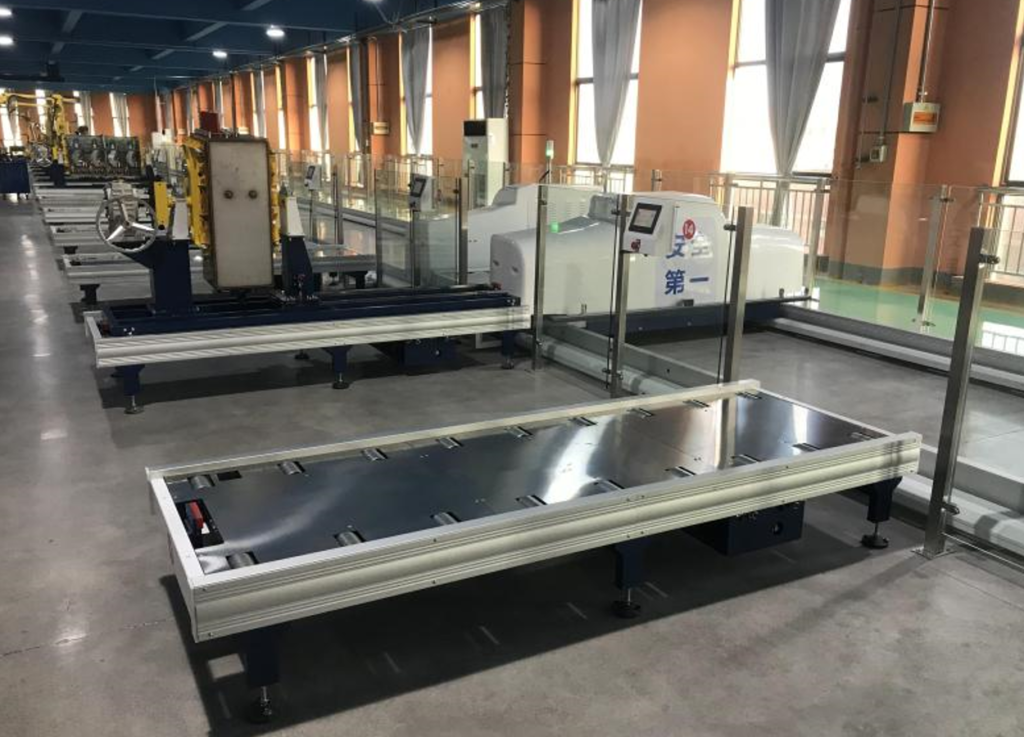
Production Line of RMU Ring Main Unit
- Production Line Structure
- Includes production line tracks and shuttle carts for transporting semi-finished and finished products.
- Workstation Modules
- Located on both sides of the production line, these modules are used to complete specific assembly or testing processes.
- Performance Testing System
- Integrates comprehensive performance testing systems for RMU ring main units, helium leak detection systems for gas compartments, and power frequency withstand voltage testing systems to ensure product quality.
- Control and Management System
- Monitors and manages the entire production process in real-time, achieving automated and informatized production workflows.
- Customized Design
- The production line can be customized and adjusted according to different RMU ring main unit models and production requirements.
- Flexible Production
- The production line is designed with downgrade workstations (e.g., manual inspection stations) to cope with failures in automated equipment, ensuring continuous production.
- Robotic Welding and MES System
- Uses robotic welding systems in conjunction with MES (Manufacturing Execution System) to achieve automated welding and production management, improving production efficiency and product quality.
By integrating advanced automation and information management systems, the production line for RMU ring main units achieves high efficiency, high quality, and high reliability in the production process, while reducing labor costs and production errors.