
Dry-Type Transformer: Structure, Assembly Process and Automated Production Line
I. Core Structure of Dry-Type Transformer (Three Main Parts + Auxiliary System)
Dry-type transformers operate without insulating oil and rely on natural air cooling. Their core components include the iron core, high and low-voltage windings, insulation system, cooling & temperature control system, enclosure and auxiliary accessories.
1. Iron Core (Magnetic Circuit Core)
- Material: Cold-Rolled Grain-Oriented silicon steel sheets (CRGO, 0.23–0.35 mm) with surface insulating coating, featuring low core loss and high magnetic permeability.
- Structure: Composed of core limbs (for winding installation) and upper/lower yokes (closed magnetic circuit). The mainstream design adopts 45° full miter lap joints and 5–7 stepped lamination, with a lamination stacking coefficient ≥ 0.96, which reduces no-load loss, noise and magnetic reluctance.
- Fastening: Fixed by upper and lower clamping frames and tension straps to ensure tight lamination and minimize vibration.
2. High & Low-Voltage Windings (Circuit Core)
Windings are concentrically sleeved on core limbs with low-voltage windings inside and high-voltage windings outside, optimizing insulation distance and reducing magnetic leakage.
- Low-voltage winding: Foil-wound structure with copper foil is widely used for large-capacity models. Equipped with DMD insulating paper and air channel support strips for excellent heat dissipation, uniform current distribution and strong short-circuit resistance.
- High-voltage winding: Made of flat copper wire or transposed conductor with multi-layer cylindrical or continuous winding structure. Inter-layer and section insulation plus tapping leads ensure reliable insulation and voltage regulation performance.
3. Insulation System (Oil-Free Solid Insulation)
Two mainstream technical solutions:
- Epoxy resin cast type (SCB series): Vacuum casting and pressure integral curing. The coil is fully encapsulated, featuring fire resistance, moisture proof, dust proof and high short-circuit withstand capability, with F/H temperature resistance class.
- Vacuum Pressure Impregnated (VPI): Windings are impregnated with insulating varnish and dried & cured. Cost-effective with superior heat dissipation, suitable for medium/low voltage and small-capacity products.
Insulation materials: DMD insulating paper, Nomex paper, epoxy resin, glass fiber, insulating cylinders and spacing blocks.
4. Cooling & Temperature Control System
- Cooling mode: AN (Natural Air Cooling), AF (Forced Air Cooling with axial fans, increasing rated capacity by 40%). Reserved air ducts between windings to enhance convection heat dissipation.
- Temperature monitoring: PT100 temperature sensors embedded in windings, matched with temperature controllers for over-temperature alarm, trip protection and automatic fan start-stop.
5. Enclosure & Accessories
Protective enclosure (IP20/IP30/IP54), on-load/off-load tap changer, insulators, connecting leads, grounding devices and base frame.
II. Core Assembly Process of Dry-Type Transformer
1. Iron Core Manufacturing Process
- Silicon steel sheet uncoiling → CNC transverse cutting line (high-precision shearing, dimensional tolerance ±0.05mm, burr-free).
- Automatic lamination: stepping lamination, stepped joint design, robot or semi-automatic stacking platform to ensure accurate alignment and tight joint clearance.
- Clamping, shaping and testing: lamination thickness, verticality and insulation resistance inspection before final assembly.
2. Winding Manufacturing Process (Key Procedure)
(1) Low-voltage Foil Winding
Fully automatic foil winding machine: copper foil uncoiling and leveling, constant tension control, alternating lamination of copper foil and DMD insulation paper, air channel strip installation, lead welding and integral shaping.
(2) High-voltage Wire Winding
CNC winding machine: flat wire with constant tension control, precise wire arrangement, inter-layer insulation laying, tapping welding, turn count monitoring and dimensional inspection.
(3) Insulation Curing (Casting / VPI)
- Vacuum casting: Coil mould loading → vacuum degassing → automatic proportioning, mixing and vacuum injection of A/B epoxy resin components → pressure infiltration → rotary heating curing → demoulding and trimming.
- VPI impregnation: Winding loading → vacuum varnish impregnation → pressure treatment → high-temperature drying and curing for uniform insulation penetration.
3. Main Unit Assembly
- Vertical installation and fixing of iron core, concentric sleeving of high and low-voltage windings with uniform coaxial clearance.
- Installation of insulation spacers, air ducts, clamping frames and fasteners with standard torque fastening to prevent loosening and noise.
- Lead welding, tap changer installation, insulation wrapping, grounding connection and overall shaping.
4. Final Assembly & Factory Testing
- Installation of enclosure, cooling fans, temperature controllers, insulators, nameplates and terminal blocks.
- Full electrical performance tests: transformation ratio, DC resistance, insulation resistance, power frequency withstand voltage, induced withstand voltage, partial discharge, no-load & load loss, temperature rise and short-circuit withstand test. Qualified products are allowed for delivery.
III. Automated Production Line for Dry-Type Transformers
1. Overall Production Line Layout
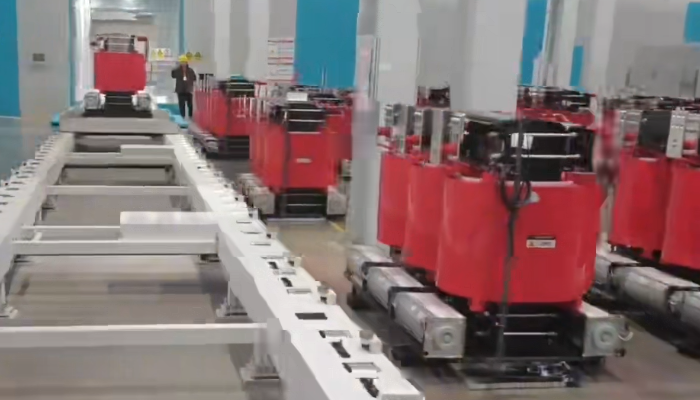
Divided into 5 integrated modules: iron core automatic line, winding automatic line, main assembly line, intelligent testing line and logistics & MES management system, realizing full-process digital and low-labor production from raw materials to finished products.
2. Core Automatic Equipment & Workstations
(1) Automatic Iron Core Production Line
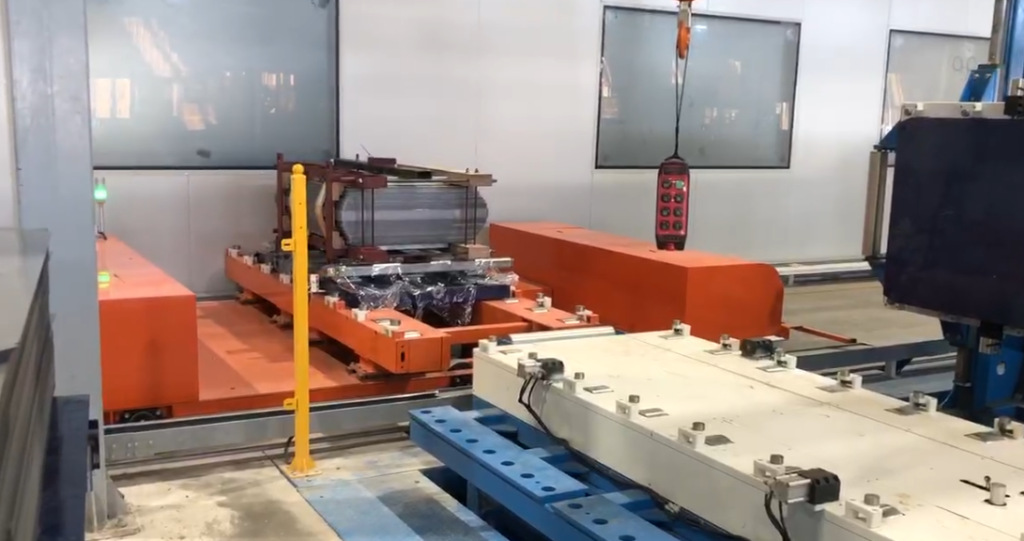
CNC silicon steel transverse cutting line, robotic automatic lamination workstation, vision positioning system, automatic clamping and flipping equipment, intelligent vertical assembly platform.
(2) Automatic Winding Production Line
Fully automatic CNC foil winding & wire winding machine, servo constant tension system, online dimensional & electrical inspection unit, automatic vacuum casting cell, intelligent VPI impregnation & drying line.
(3) Automated Assembly & Logistics
Robot assembly workstation (automatic winding hoisting, fastener locking and lead welding), AGV intelligent material handling system, speed chain conveyor assembly line, error-proof tooling and full-cycle barcode traceability.
(4) Intelligent Quality Inspection System
Automatic comprehensive test bench for electrical performance, visual appearance inspection, real-time data acquisition, digital twin monitoring and MES/PLM collaborative management, realizing automatic judgment, data archiving and defective product isolation.
3. Advantages of Automated Production Lines
- Efficiency: 30%–50% higher production capacity, shorter delivery cycle and over 50% labor reduction.
- Quality: Stable product consistency, optimized control of loss, noise and partial discharge, and lower defective rate.
- Digitalization: Full-process traceability, flexible model changeover, intelligent scheduling and remote equipment operation & maintenance.
IV. Key Process Control Points
- Iron core: Strict control over lamination accuracy, joint clearance and clamping force to reduce no-load loss and operating noise.
- Winding: Stable winding tension, uniform wire arrangement, standardized insulation thickness and welding quality to ensure insulation reliability and short-circuit resistance.
- Casting process: Accurate vacuum degree, resin ratio, temperature and pressure curing curve to avoid internal bubbles and insulation cracking.
- General assembly: Guaranteed coaxiality, uniform gap, standard fastening torque and lead insulation for optimal electrical and mechanical stability.